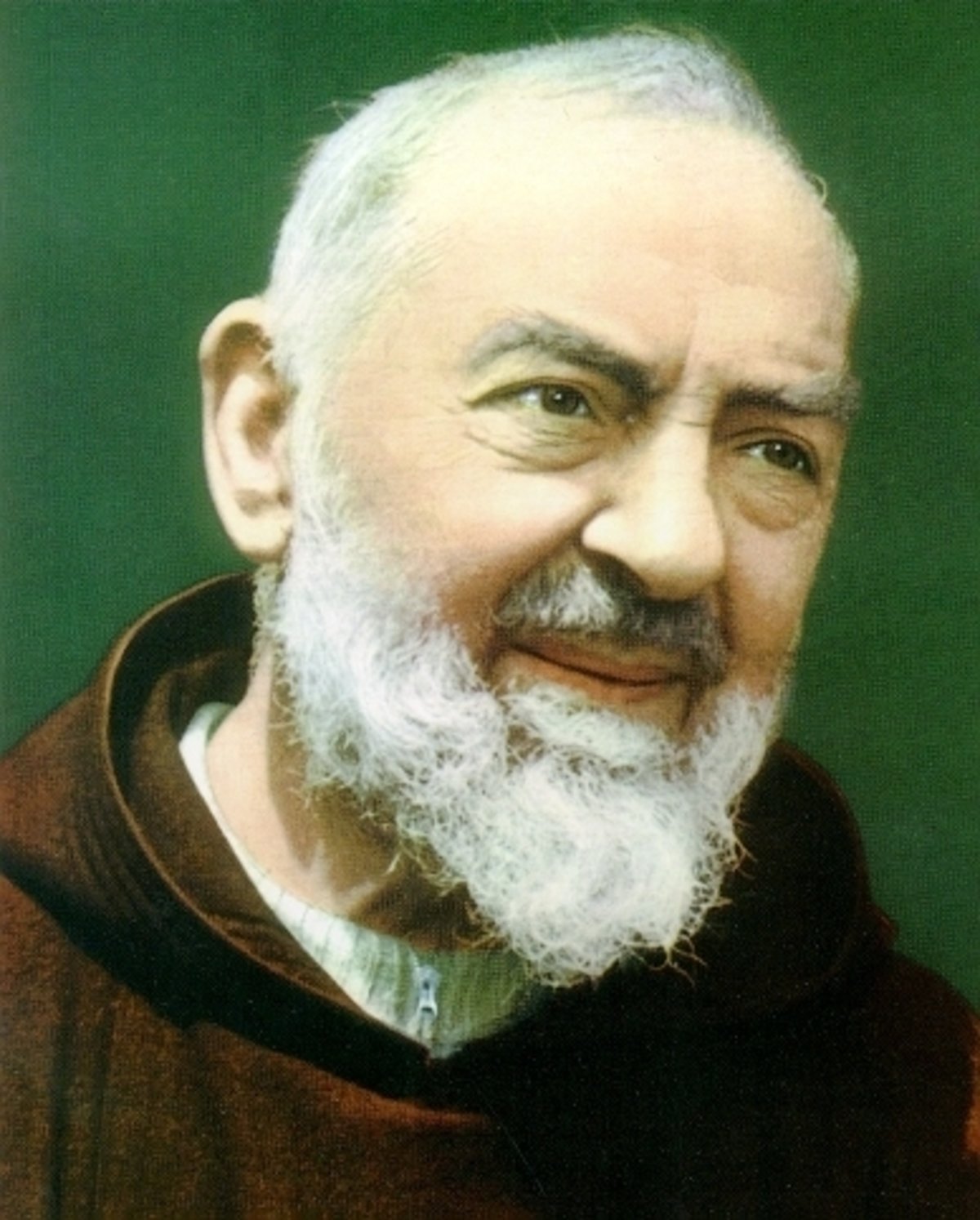
Padre Pio at San Giovanni Rotondo
In September 1918, a Capuchin friar was praying in the choir of a small church in San Giovanni Rotondo, a town in southern Italy. His name was Padre Pio. He was thirty-one years old, had spent much of his young life in poor health and was still a relatively unknown priest.
On September 20, he reported an experience during prayer that left wounds on his hands, feet and side, resembling those of Christ crucified. The wounds became known as the stigmata. Soon people began making their way to the friary, some out of devotion, others out of curiosity, and some looking for an explanation.
What had happened? Pio understood it as a religious experience. Doctors examined him. Church authorities investigated. People drew very different conclusions about what the wounds meant. For a man who wished to live as a friar, the attention would become a burden he carried for decades.
And this is where his story becomes rather more interesting than a list of marvels.
Francesco before he was Padre Pio
He was born Francesco Forgione in Pietrelcina on May 25, 1887. The family was not wealthy. From childhood he was drawn to religious life and was especially impressed by the Capuchin friars, recognizable by their brown habits, sandals and simple manner of living. At sixteen, he entered their novitiate and took the name Pio.
He was ordained a priest in 1910, but his health repeatedly disrupted the ordinary routine of a friary. He spent long periods at home. Military service during the First World War was also interrupted by illness. In 1916 he came to San Giovanni Rotondo, where, apart from the interruptions of his earlier years, the rest of his life would be lived.
The Capuchin vocation was not mysterious in its daily requirements: prayer, community life, the Mass, obedience, work and care for others. Pio lived within that pattern. He did not have to invent a form of holiness. He had to be faithful to the one he had promised to live.
Then came the wounds, and with them the crowds.
When people came to see the wounds
By 1919, reports of Pio’s stigmata had spread well beyond the little friary. There were medical examinations, petitions and visits from officials. Devotees saw a sign of God’s nearness. Others raised questions about the wounds and their cause. The Holy Office did not simply wave the questions away: in 1923 it stated that the supernatural character of the reported phenomena had not been established.
The scrutiny continued. In 1931, the Holy See restricted Pio’s public priestly ministry; he could celebrate Mass only privately. For a priest whose life centered on the sacraments, this was no small thing. Public celebrations resumed in 1933, and the ministry of confession followed in 1934. The fact that he was later canonized should not make us forget how long and difficult those intervening years were.
The Church has good reason to be careful with claims of the extraordinary. Crowds may be moved by wonder, but wonder alone is not a measure of sanctity. There is an old and useful Catholic instinct here: if something seems supernatural, the first duty is not to spread it, but to examine it.
Pio’s public reputation grew all the same. Reports of miracles and other extraordinary experiences were attached to his name. Those belong to the history of devotion surrounding him, but they are not all equally documented, and Catholics are not required to accept every story told about a saint.
The confessional
There is another way to understand why people kept coming to San Giovanni Rotondo. Many came to confess their sins. Pio spent long hours hearing confessions, sometimes more than twelve hours in a day. He was known for being direct, at times severe, in the confessional. That manner has not appealed equally to everyone, but it arose within a ministry that treated sin, repentance and reconciliation as serious matters.
For the Church, confession is not a performance in which a priest demonstrates how much he knows about a soul. It is the sacrament in which Christ offers mercy through an ordinary human minister. Pio’s calling was to direct people to that mercy, not to make himself its source.
The same was true of the Mass. Pilgrims who witnessed his celebrations often spoke about their intensity. He approached the Eucharist with the conviction that the Passion of Christ was not merely a distant event to be remembered, but a sacrifice made present sacramentally. Whether or not a visitor saw anything unusual, there was at least this: a priest who appeared to mean every word he prayed.
A hospital on the hill
Pio’s concern for suffering did not remain inside the friary. In the years after the Second World War, he worked toward the establishment of a modern hospital in San Giovanni Rotondo. The Casa Sollievo della Sofferenza, the House for the Relief of Suffering, opened on May 5, 1956.
It is an important part of the story because the hospital was built for people whose pain required more than words of consolation. They needed physicians, nurses, beds, medicine and skilled attention. Padre Pio’s world was full of prayer, but there was nothing in that prayer that made medical care unnecessary.
He continued his life at the friary as age and illness made themselves felt. His last Mass was on September 22, 1968. He died the next day, aged eighty-one.
The friar who once attracted visitors because of wounds became known to generations who had never seen him. Some would speak of the stigmata first. Others would remember the confessional or the hospital. Perhaps it is best to keep all three in view: a man who suffered, a priest who heard other people’s burdens and a community that made room for the sick.
Padre Pio once described himself simply as a poor friar who prayed. The description was modest. His life was not simple. But the words point to something that remained when the noise around him rose and fell: the work of a priest, day after day, in one small Italian town.
Pray and explore
Padre Pio’s feast day is September 23. The Act of Contrition and the Divine Mercy Chaplet are natural places to continue reflecting on God’s mercy.
Sources and historical notes
Dates, ministry restrictions and the hospital are documented by the Holy See’s biographical account, Vatican City State’s historical summary and the chronological biography in Voce di Padre Pio. Reports of extraordinary phenomena are described as claims or religious testimony, rather than independently demonstrated supernatural events. The 1923 Holy Office judgment should not be mistaken for a permanent verdict on Padre Pio’s sanctity.