Memento Mori: Why Catholics Remember Death
There is a phrase that can sound almost unsettling the first time you hear it:
Memento mori.
Remember that you will die.
At first, it can sound grim. Why spend time thinking about death when life already gives us enough to worry about?
But the Christian tradition does not remember death because life is meaningless.
We remember death because life matters.
Our days are limited. The people we love will not always be here. Neither will we. And remembering that can change the way we live today.
Remembering death is not the same as fearing it
Scripture does not pretend that human life lasts forever.
The psalmist prays:
“Teach us to count our days aright, that we may gain wisdom of heart.”
Psalm 90:12
Notice what he asks for.
Not fear.
Wisdom.
There is something about remembering that our time is limited that can bring life into focus.
The argument that seemed so important yesterday begins to look smaller.
The apology we keep postponing becomes harder to justify.
The prayer we have been putting off begins to matter.
The time we waste worrying about things we cannot control becomes easier to recognize.
Memento mori is not meant to make us obsessed with dying. It is meant to help us stop living as though we have unlimited time.
Christianity does not avoid death
The Catholic faith is unusually direct about death.
Every Ash Wednesday, we are reminded that we are dust and will return to dust.
In the Hail Mary, we ask Our Lady to pray for us “now and at the hour of our death.”
The Church prays for the dead.
We celebrate All Souls’ Day.
We keep crucifixes before us.
And at every Mass, we proclaim the death and Resurrection of Christ.
Death is not hidden from Christian life because Christianity makes a claim much greater than pretending death does not exist.
It claims that Christ has entered into death and defeated it.
The Catechism teaches that death marks the end of our earthly pilgrimage, the time in which we receive God’s grace and respond to Him. It also teaches that Christ transformed death through His own death and Resurrection. See CCC 1007-1014.
That changes what memento mori means for a Christian.
We remember that we will die, but we remember it while looking toward Christ.
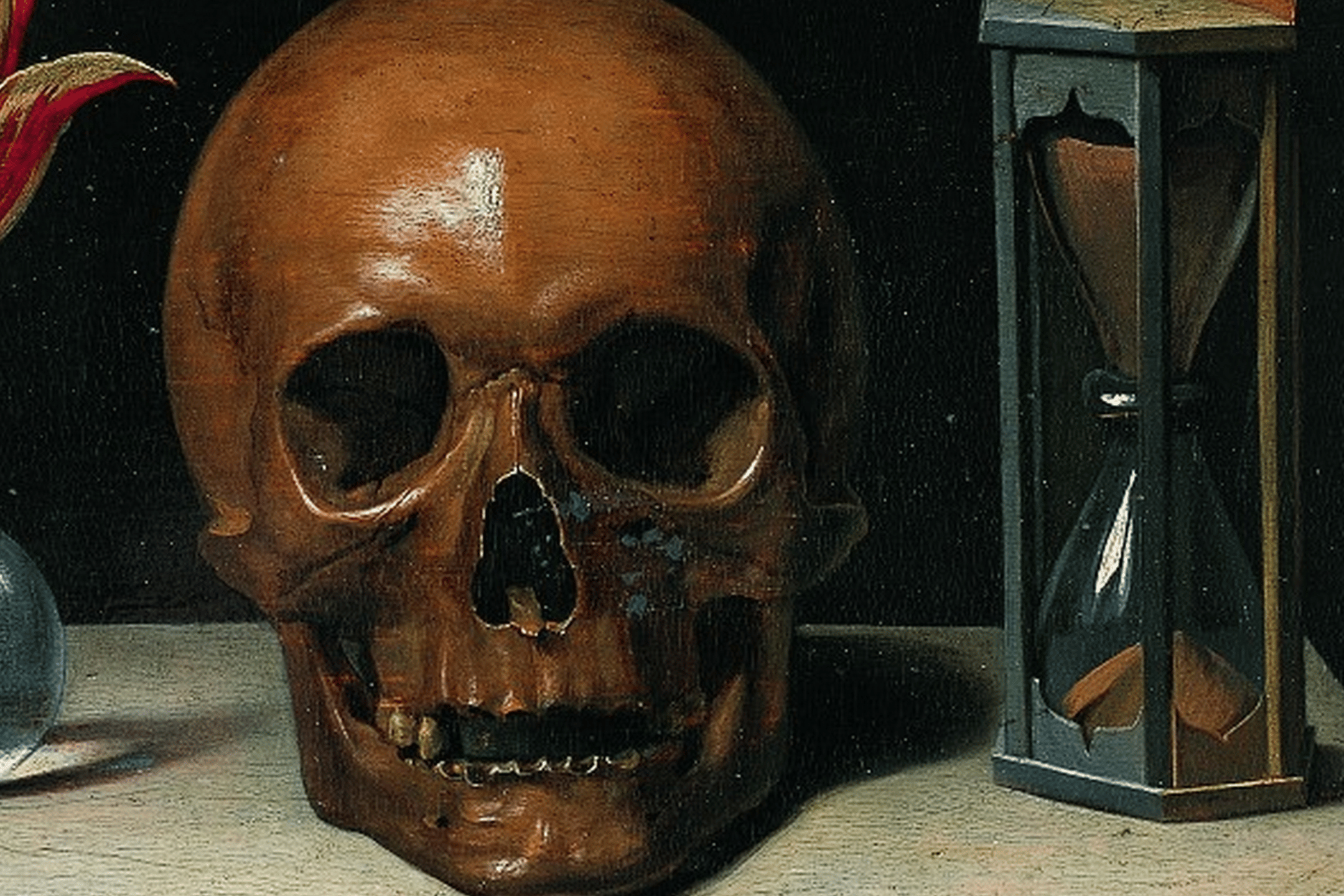
The skull is not the end of the story
This is why skulls sometimes appear in Christian art and devotional imagery.
They are not there simply to be dark or dramatic.
They remind us of something we spend much of our lives trying not to think about:
Everything here passes.
Our possessions.
Our accomplishments.
Our appearance.
Our status.
The plans we make.
Even our bodies.
But the Catholic understanding of death does not stop at the grave.
We profess in the Creed that we believe in the resurrection of the body and life everlasting.
That distinction matters.
Memento mori without the Resurrection can become despair.
Christian memento mori points beyond the grave.
Death is real. Judgment is real. Eternity is real.
But so is the mercy of God.
So is the Cross.
So is the empty tomb.
The Christian remembers death because Christ has changed what death means.
What would change if you remembered?
There is a simple question hidden inside memento mori:
If I really remembered that my life is temporary, would I live today differently?
Maybe you would forgive someone.
Maybe you would go to Confession.
Maybe you would finally make time to pray instead of waiting until life becomes less busy.
Maybe you would put your phone down when someone you love is talking to you.
Maybe you would stop carrying a resentment that has already taken too much of your life.
Maybe you would worry less about being noticed.
Maybe you would tell someone you love them.
Maybe you would take more seriously the parts of your life that prepare you for eternity.
This is where remembering death becomes practical.
It is not mainly about skulls, Latin phrases, artwork, or devotional objects.
It is about conversion.
We usually assume there will be more time
One of the easiest assumptions to make is that there will always be another opportunity.
Another Sunday.
Another Confession.
Another conversation.
Another chance to repair the relationship.
Another time to pray.
Another day to become the person we know God is asking us to become.
Usually there is another day.
Until there isn’t.
That does not mean we should live anxiously, constantly wondering whether today will be our last.
Christian preparation for death is not panic.
It is faithfulness.
Do what God has given you to do today.
Love the people in front of you.
Receive the sacraments.
Repent when you fall.
Pray even when prayer feels ordinary.
Try again.
The goal is not to predict the hour of our death.
The goal is to live in such a way that we do not need to fear meeting Christ when that hour comes.
Memento mori and the things we cannot take with us
We spend enormous amounts of energy building things that eventually have to be left behind.
Money matters.
Work matters.
Our homes matter.
Responsibilities matter.
There is nothing especially holy about neglecting ordinary life.
But ordinary things become disordered when we begin treating temporary things as though they were permanent.
Memento mori puts them back in their proper place.
You can pursue a career without making it your identity.
You can enjoy possessions without believing they can satisfy you.
You can plan for the future without pretending you control it.
You can love this life deeply without expecting it to be the final one.
Remembering death does not make creation less beautiful.
It can make us more grateful for it.
A meal with family matters because it will not happen forever.
A child’s voice changes.
Parents grow older.
Friends move away.
Seasons pass.
The ordinary moment we barely notice today may someday be something we would give anything to experience once more.
Mortality gives weight to ordinary life.
The point is not death. The point is Christ.
It would be easy to turn memento mori into another aesthetic.
A skull on a desk.
A Latin phrase on a wall.
Something that looks ancient and serious.
But if remembering death does not lead us toward Christ, repentance, gratitude, mercy, and love, then we have missed its purpose.
The Church does not ask us to prepare for death because death gets the final word.
It asks us to prepare because Christ does.
So remember that you will die.
Not because your life is insignificant.
Because it is precious.
Because this day will not come again.
Because the people God has placed in your life are not guaranteed to be there tomorrow.
Because grace is being offered to you now.
And because the Christian hope is not simply that death will come someday.
It is that when it does, we belong to the One who has already passed through it and risen.
A simple practice
You do not need to spend the day thinking about your death.
Instead, let memento mori become a small examination of your life.
At the end of the day, ask:
If today had been my last full day, is there anything I would wish I had done differently?
Then do not turn the answer into guilt.
Bring it to God.
Ask for mercy where you failed.
Give thanks for what was good.
And begin again tomorrow, if He gives you another day.
That may be one of the quiet gifts of remembering death.
It teaches us how to live.
Scripture to pray with: Psalm 90:12
For further reading: Catechism of the Catholic Church, 1007-1014