Little Faith Is Still Faith
There is a detail at the start of this Gospel that is easy to rush past. Before Jesus walks on the water, before Peter steps out of the boat, before the storm and the rescue, Jesus sends the crowds away and climbs the mountain alone to pray. He does this at the end of a long day of ministry, right after feeding five thousand people with five loaves and two fish. He has every reason to be exhausted. Instead, his first move is toward solitude and prayer.
It is worth sitting with that for a moment. The busier and more demanding life becomes, the more Jesus withdraws to be with the Father. That is not an escape from his mission. It is the source of it. Anyone who has tried to pour themselves out for others day after day, whether at work, at home, or in ministry, knows what it costs when that quiet time with God gets crowded out. This Gospel begins by showing us what Jesus considered non-negotiable.
While he prays on the mountain, the disciples are out on the water fighting a storm. They are not lost. They are not disobedient. They did exactly what Jesus told them to do, and they still end up in the middle of a struggle, tossed by waves with the wind against them. That is worth naming plainly: doing what God asks does not exempt us from storms. Following Christ faithfully does not guarantee smooth water. Sometimes it leads straight into it.
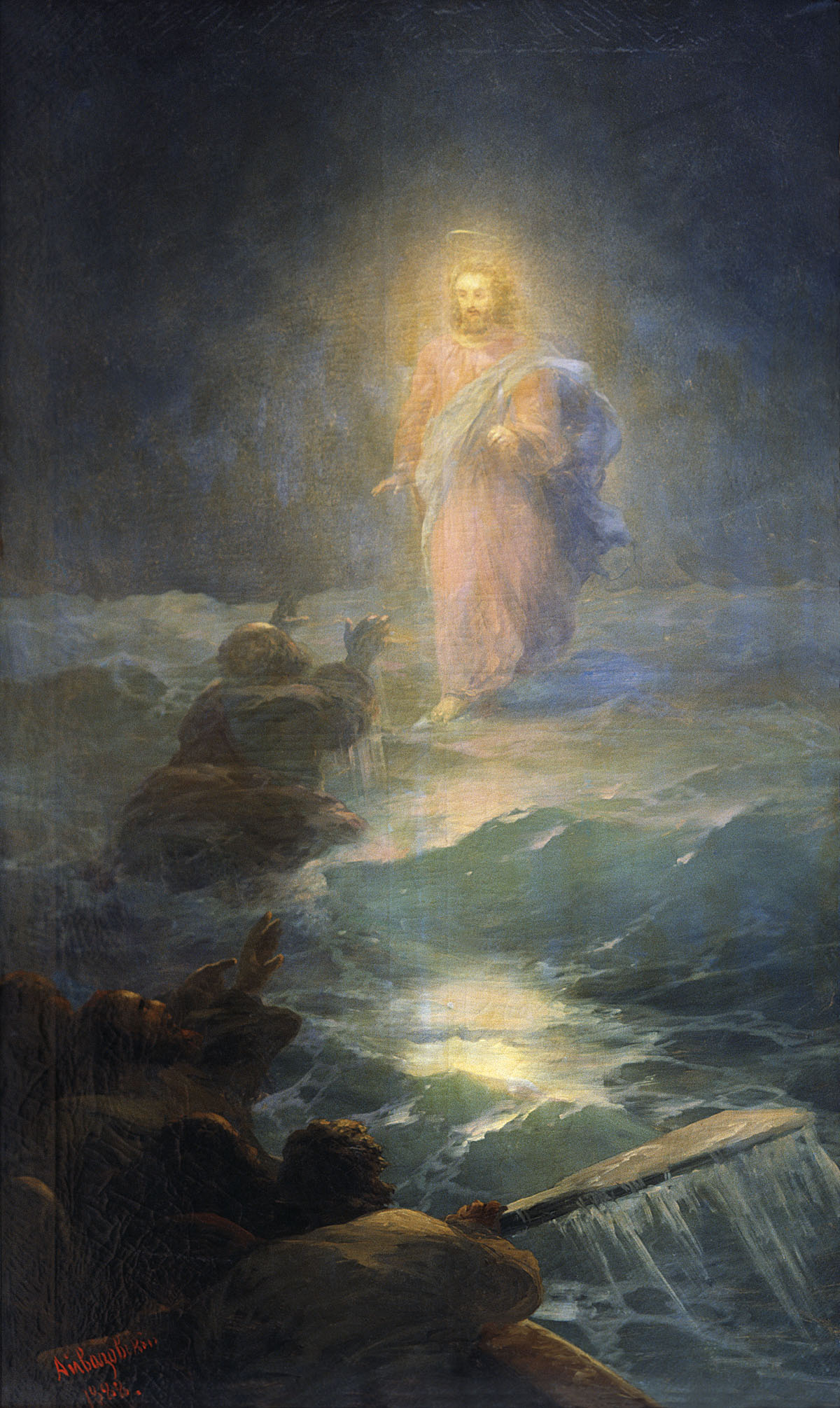
Then, in the fourth watch of the night, the darkest and most exhausted hour, Jesus comes to them walking on the sea. And their first reaction to seeing him is fear. They mistake him for a ghost. It is a striking irony. The very thing that terrifies them is the presence of the one who has come to save them. How often does that happen in our own lives? God draws near in some unexpected or unsettling way, through a hard conversation, a diagnosis, a financial setback, a call to change, and our first instinct is fear rather than recognition.
Jesus does not scold them for being afraid. He simply speaks into it: “Take courage, it is I; do not be afraid.” That word, translated “it is I,” echoes the divine name God gives Moses at the burning bush: I AM. Jesus is not just offering comfort. He is revealing who he is. The one walking toward them through the storm is the same God who has never abandoned his people.
Then comes Peter, impulsive and sincere as always. “Lord, if it is you, command me to come to you on the water.” And Jesus says only one word back: “Come.” What follows is one of the most human moments in all the Gospels. Peter actually gets out of the boat. He actually walks on the water. For a few steps, faith carries him somewhere that should be impossible. But then he notices the wind. He looks away from Jesus and back at the storm, and he begins to sink.
This is not a story about failure so much as it is a story about the honesty of faith. Peter’s cry, “Lord, save me,” is itself a kind of prayer, maybe the most important one in the whole passage. He does not swim back to the boat on his own strength. He does not pretend he has it together. He calls out, and Jesus is there immediately, hand extended, before Peter even finishes sinking.
“O you of little faith, why did you doubt?” is not said in anger. It reads more like a father steadying his child, naming what happened so the lesson can take root. Little faith is still faith. It is enough to get you out of the boat. It is enough for Jesus to catch you when it falters. The point was never that Peter had to be perfect. The point was that Jesus was close enough to reach.
Once they climb back into the boat together, the wind dies down, and those in the boat do him homage, declaring, “Truly, you are the Son of God.” It is the first time in Matthew’s Gospel that the disciples say this. It took a terrifying night, a failed attempt at walking on water, and a rescue to bring them to that confession. Growth in faith is rarely tidy. It often comes through the very storms and stumbles we would have chosen to avoid.
The passage ends at Gennesaret, where people bring their sick and simply ask to touch the tassel of his cloak. No dramatic request, no elaborate faith required. Just a reach toward him, and it was enough. That is the same invitation extended to Peter and to us. We do not need to have it all figured out before we come to Christ. We only need to reach.
A short prayer
Lord Jesus, when the wind rises and my eyes drift from you to the storm, reach for me before I sink. Give me the courage to get out of the boat, and the honesty to call out when I falter. I believe. Help my little faith. Amen.
Continue reflecting:
Peter’s “Come” is not the only courageous yes in Scripture. Read what Mary’s fiat teaches us about surrender.
For further reading:
Abandonment to Divine Providence by Jean-Pierre de Caussade, a short classic on trusting God’s hand in the present moment rather than the storm around you. Find it here (paid link)
As an Amazon Associate, Christus Lumen earns from qualifying purchases.