Bridget of Sweden and the Road to Rome
When Bridget of Sweden arrived in Rome in 1349, the pope was not there.
He was in Avignon, in southern France, where the papal court had been based for decades. Rome was still the city of Peter and Paul, still crowded with churches and ancient memories, but the bishop of Rome was governing from somewhere else. Bridget had come in part to seek approval for a religious community she hoped to establish. She would also spend years urging the popes to return.
It is worth remembering who was making these demands. She was not a bishop, a cardinal or an abbess. She was a Swedish widow, a mother of eight children, who had once belonged to the household of a queen. By the standards of her time she was a woman with connections, certainly, but no ecclesiastical office. She had, however, an unusually firm idea of what she believed God was asking of her.
That conviction had been formed long before she ever saw Rome.
A household in Sweden
Bridget was born in 1303 into a noble Swedish family. Her parents were devout, and her upbringing gave her both religious education and an acquaintance with public life. She married Ulf Gudmarsson, a prominent nobleman and royal official. Their marriage lasted twenty-eight years and brought eight children, including Catherine, who would later be honored as a saint herself.
There is a tendency to hurry through the married years when telling the stories of medieval mystics. The miracles seem more interesting. But in Bridget’s case that would leave out much of the woman. Her home, her children and her marriage occupied nearly three decades of her life. According to Pope Benedict XVI’s account, she and her husband practiced works of charity, followed a Franciscan way of life as laypeople and established a hospital. Bridget also served at the royal court, helping Queen Blanche of Namur become accustomed to Sweden.
She knew something about the responsibilities of people who held power. She also knew something about the exhaustion, worry and daily decisions of family life. Neither experience was wasted when she became a religious reformer.
In 1341, Bridget and Ulf set out on pilgrimage to Santiago de Compostela in Spain. It was a long journey across medieval Europe, undertaken years before modern pilgrim routes had hostels at convenient intervals. After returning to Sweden, Ulf eventually withdrew to the Cistercian monastery of Alvastra, where he died in 1344.
Bridget’s life changed. The marriage was over, but her vocation was not. She did not remarry. Instead, she devoted herself more fully to prayer, charitable work and the religious experiences that had begun to shape her life.
The visions and the work of writing
Near Alvastra, Bridget began to report revelations in which she believed Christ, the Virgin Mary and saints spoke to her. She was convinced these experiences came with obligations: personal conversion, a deeper devotion to Christ’s Passion and the need to speak candidly to those charged with governing the Church and society.
She dictated her experiences to priest-secretaries, who translated them from Swedish into Latin. The collection eventually became known as the Revelationes. Some passages are tender meditations on the life and suffering of Christ. Others are severe admonitions. Bridget was not content to offer comfort alone; she believed repentance was sometimes required of the comfortable.
Here we should pause to make a distinction that the Church itself makes. Bridget is recognized as a saint. That does not mean every reported word of her private revelations has been guaranteed as a literal message from heaven. Pope Benedict XVI, drawing on John Paul II, explained that the Church recognized her holiness without pronouncing on each individual revelation. A Catholic may read such writings as spiritual literature while judging them in light of Scripture and Church teaching.
This does not drain Bridget’s story of wonder. It helps us attend to the woman herself: the discipline of prayer, the courage to speak, and the enormous labor of turning religious conviction into a life of service.
A widow who wrote to popes
Bridget left Sweden for Rome in 1349. The journey brought her close to the places associated with the apostles, but also confronted her with the disorder of Church politics. She pressed for the papacy to return to Rome from Avignon. She was not alone in wanting that, and she did not live to see the eventual permanent return in 1377.
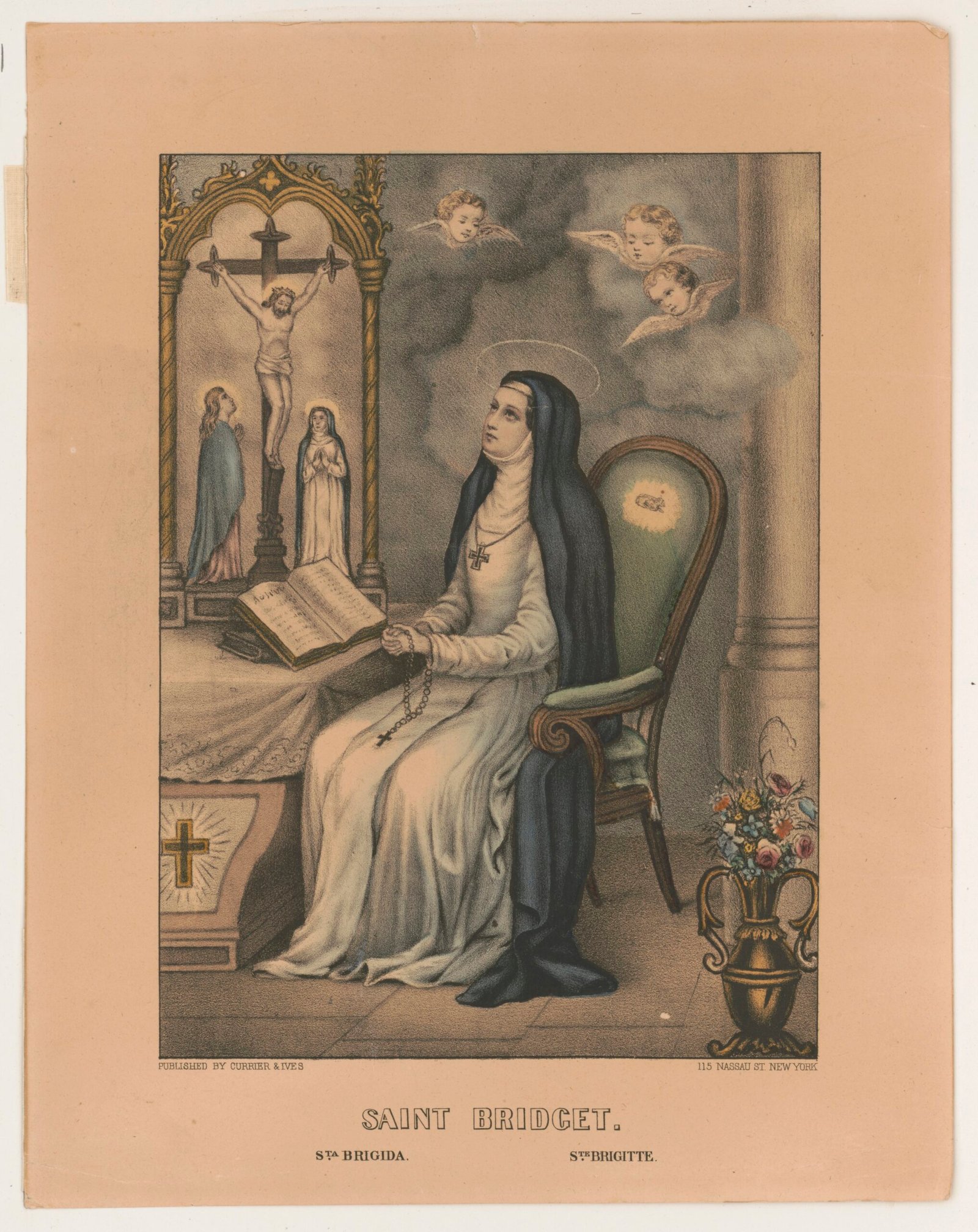
In the meantime, she worked toward a religious community dedicated to the Holy Savior. Its form was unusual: women and men living in separate communities under a shared rule, with an abbess holding a leading role in its governance. The house at Vadstena in Sweden became the center of the order that bears her name.
She traveled through Italy and visited shrines. Near the end of her life, in the early 1370s, she made a pilgrimage to the Holy Land, accompanied by members of her spiritual circle. Her daughter Catherine was often at her side. One gets the sense of a life that remained thoroughly on the move, even though much of what Bridget most valued took place in prayer.
She died in Rome on July 23, 1373. Her remains were later brought back to Sweden and laid to rest at Vadstena. She was canonized in 1391.
Why Bridget is still worth meeting
Bridget is remembered as a mystic, and rightly so. Yet there is something wonderfully unromantic about much of her holiness. She had children to raise, a husband to care for, poor people to help, journeys to make and difficult messages to deliver. Her devotion to Christ’s suffering did not make her indifferent to the suffering immediately in front of her.
In an age when it could be easy to mistake private spirituality for a retreat from the world, Bridget did not retreat. She prayed, wrote, traveled and argued. She brought the responsibilities of a household into the larger household of the Church, where she found that the people in charge were not always eager to be corrected.
There are many ways to tell a saint’s life, but Bridget’s resists being reduced to visions alone. She was a wife before she was a widow, a mother before she was a pilgrim in Rome, and a Christian whose faith insisted upon being lived in public as well as in private.
Perhaps that is why her story remains so unsettling and so recognizable. God did not have to wait for her ordinary life to be finished before beginning His work in it.
From Bridget’s revelations
Bridget’s writings have stories of their own. In Bridget of Sweden and the Souls Before the Judge, we follow her accounts of death, judgment and mercy. The Wounds of Christ and the Prayers Attributed to St. Bridget explores how the devotion to Christ’s wounds developed, and why its historical claims deserve careful scrutiny.
Pray and explore
St. Bridget’s feast day is July 23. Explore the traditional prayers associated with St. Bridget in the Christus Lumen Prayer Library. Popular devotions attributed to her have circulated in many versions, and not every historical claim or promise attached to them is authenticated; they should be read with that distinction in mind.
Sources and historical notes
For Bridget’s life, see Benedict XVI’s general audience of October 27, 2010 and the Catholic Encyclopedia account. On the distinction between private revelations and the Church’s public Revelation, see the USCCB’s explanation of popular devotional practices. Attributed visions and prayers are treated as devotional traditions, not as historical evidence automatically established by canonization.